In precision manufacturing and laboratory environments, airborne particles can affect product quality, particularly when working with sensitive components or contamination-sensitive materials. Maintaining a clean workspace is therefore an important part of supporting reliable processes and consistent results.
High-Efficiency Particulate Air (HEPA) laminar flow stations provide localized filtered-air environments for tasks that require greater control over airborne contamination. Rather than treating an entire production area as a cleanroom, manufacturers can use these stations to establish dedicated clean-air work zones for specific operations.
Understanding how HEPA laminar flow stations work, where they are most useful, and what factors influence their performance can help organizations select equipment that fits their processes and workspace requirements.
What Is a HEPA Laminar Flow Station?
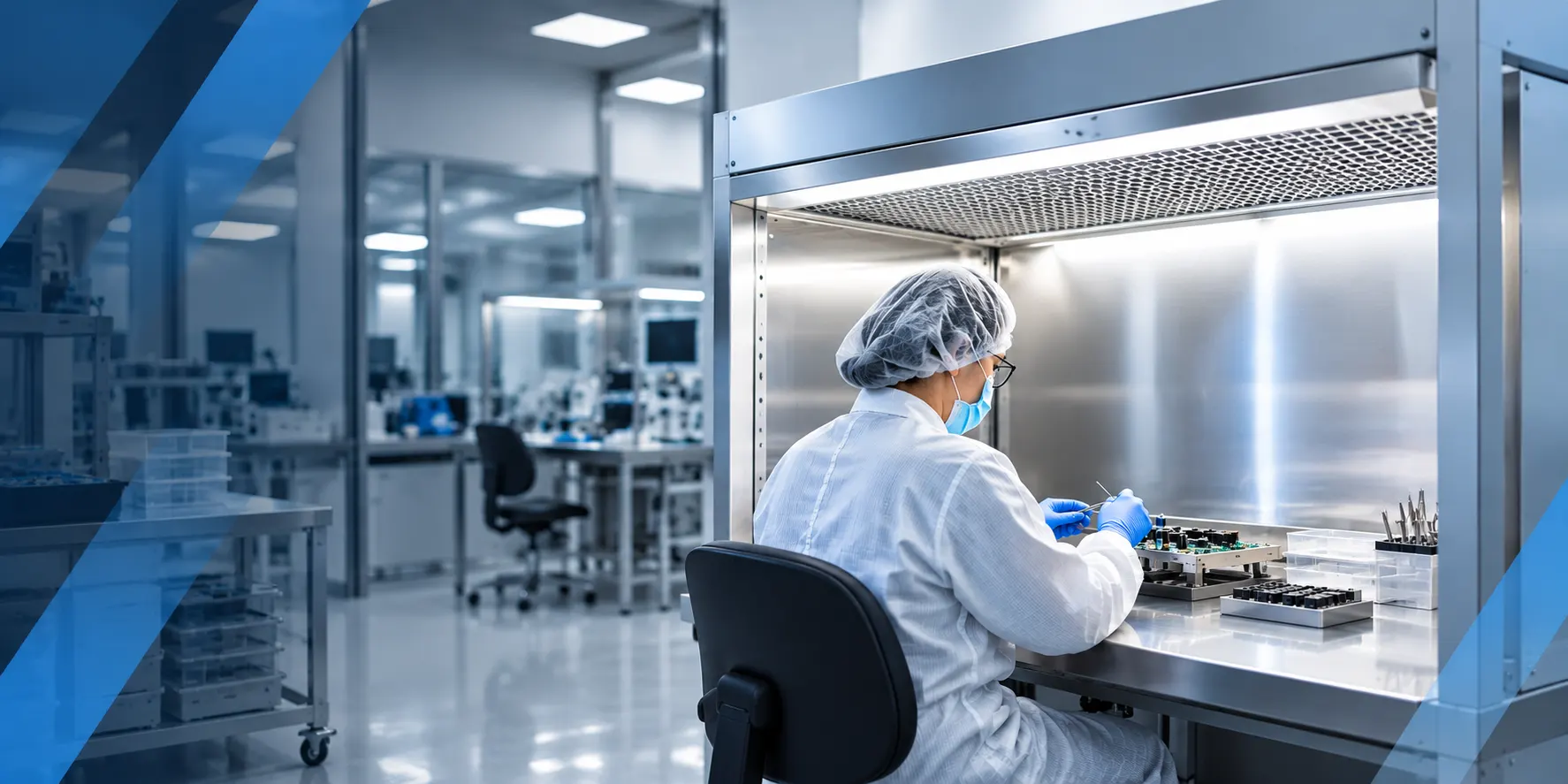
A HEPA laminar flow station is a specialized workstation that delivers filtered air across a designated work area to help protect sensitive products and materials from airborne particles. These stations combine high-efficiency filtration with controlled, unidirectional airflow to maintain cleaner conditions around critical operations.
According to the U.S. Environmental Protection Agency’s explanation of HEPA filtration, HEPA filters can theoretically remove at least 99.97% of airborne particles measuring 0.3 microns in diameter. This filtration capability helps reduce the concentration of particles entering the work zone.
The filtered air then moves through the workspace in a consistent direction, helping carry particles away from sensitive materials. This combination makes HEPA laminar flow stations useful for applications where localized contamination control is necessary, but the surrounding workspace may not require the same level of air cleanliness.
How Do HEPA Laminar Flow Stations Work?
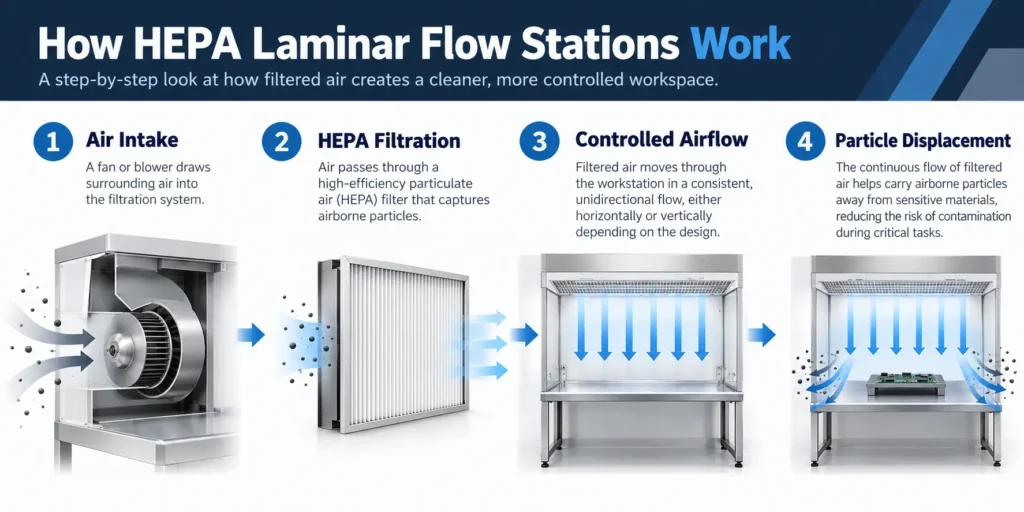
HEPA laminar flow stations use a fan or blower system to draw air through a high-efficiency filter before distributing it across the work area. The filtered air follows a controlled path designed to minimize turbulence and reduce the movement of airborne particles into critical work zones.
As air moves through the station, it helps displace particles generated by nearby activities or introduced during material handling. However, the effectiveness of this process depends on maintaining appropriate airflow conditions. Equipment placement, operator movements, and objects positioned near the filter can disrupt the intended airflow pattern.
For this reason, proper workstation design is just as important as filtration performance. A station must provide sufficient space for the task while allowing filtered air to move through the work area without unnecessary obstructions.
Horizontal vs. Vertical Laminar Flow Stations
HEPA laminar flow stations are generally available in horizontal and vertical configurations. While both deliver filtered air to a designated work area, the direction of airflow affects how equipment and materials should be arranged.
Horizontal Laminar Flow Stations
Horizontal laminar flow stations direct filtered air from the rear of the workstation toward the operator-facing opening. This configuration can provide a relatively direct airflow path across components positioned on the work surface.
Horizontal airflow may be suitable for precision assembly or inspection tasks where materials can be arranged without blocking the filtered air. However, taller equipment or improperly positioned objects can create areas of disturbed airflow, making workspace organization particularly important.
Vertical Laminar Flow Stations
Vertical laminar flow stations deliver filtered air downward from an overhead filtration system toward the work surface. This configuration can accommodate certain equipment layouts and processes that benefit from overhead air distribution.
Vertical airflow may be preferable when workstation depth, component positioning, or equipment access makes horizontal airflow less practical. However, objects placed beneath the filter can still interrupt airflow, so the arrangement of tools and materials must be carefully considered.
The appropriate configuration depends on the process, equipment dimensions, and operator interaction. Evaluating these factors early helps ensure the airflow design supports the intended application.
Industries That Benefit From HEPA Laminar Flow Stations
HEPA laminar flow stations are used in industries where particulate contamination can interfere with sensitive manufacturing, inspection, or handling processes. Although cleanliness requirements vary by application, localized filtered-air workstations can help organizations establish more controlled conditions for critical tasks.
Semiconductor and Electronics Manufacturing
Semiconductor and electronics manufacturing often involves delicate components that require careful handling and protection from airborne particles. HEPA laminar flow stations can support selected assembly, inspection, and component-handling activities where cleaner working conditions are necessary.
These applications may also require electrostatic discharge (ESD) protection. When selecting a workstation, manufacturers should consider both contamination control and compatibility with ESD-sensitive equipment to ensure the workspace meets the needs of the process.
Medical Device Manufacturing
Medical device manufacturers may require controlled environments during component assembly, inspection, and packaging. HEPA laminar flow stations can provide localized filtered-air areas for suitable processes where airborne particle control is part of the manufacturing requirements.
However, filtration alone does not establish regulatory compliance. Manufacturers must determine the cleanliness requirements of each process and verify that the selected workstation supports the necessary environmental controls.
Biotechnology and Laboratory Applications
Biotechnology laboratories may use HEPA laminar flow stations for nonhazardous sample preparation, equipment assembly, and other activities where protecting materials from airborne particles is the primary concern.
These stations should not be confused with biological safety cabinets, which are designed for applications requiring additional containment. The distinction is important when determining whether equipment must protect the product, the operator, or both.
Aerospace and Defense Manufacturing
Aerospace and defense manufacturers often work with precision components that must meet demanding quality and cleanliness specifications. Localized clean-air workstations can support selected assembly, inspection, and handling operations where particle contamination needs to be minimized.
For these applications, workstation dimensions, material compatibility, and documented cleanliness requirements should guide equipment selection. The objective is to establish an environment that supports the process without restricting access to complex or delicate components.
Key Benefits of HEPA Laminar Flow Workstations
HEPA laminar flow stations offer several practical advantages for organizations managing contamination-sensitive operations. Their value comes from combining filtered airflow with a workstation designed around the specific task.
Improved Contamination Control
The primary benefit of a HEPA laminar flow station is its ability to reduce airborne particle exposure within a defined work area. Filtered, directional airflow helps move particles away from sensitive materials, supporting cleaner conditions during assembly, inspection, and handling.
The Centers for Disease Control and Prevention’s guidance on laminar airflow systems describes how unidirectional filtered airflow can help reduce turbulence and control particle movement within protected environments.
Localized Clean-Air Protection
A dedicated clean-air workstation allows manufacturers to focus contamination-control measures on operations that require them. This can be useful when only certain production steps need enhanced airborne particle control.
However, a station’s cleanliness level must be established through appropriate testing. The International Organization for Standardization (ISO) 14644-1 cleanroom and clean-zone classification standard defines how air cleanliness is classified based on airborne particle concentrations.
Adaptable Workstation Configurations
Manufacturing processes often change as new products, equipment, or production requirements are introduced. A configurable workstation can accommodate different work surface dimensions, equipment arrangements, and operator needs without requiring every process to follow the same layout.
This flexibility can be especially valuable for facilities handling multiple product types or specialized assembly operations.
Better Workflow Integration
A well-designed workstation should allow operators to complete tasks efficiently while maintaining the required clean-air conditions. Appropriate working heights, accessible equipment, and organized work surfaces can help reduce unnecessary movements and improve day-to-day usability.
Bench-Tek’s custom cleanroom workbenches and modular workstation solutions offer configurable features that help manufacturers align workstation layouts with their operational requirements.
What to Consider When Choosing a HEPA Laminar Flow Station
Selecting a HEPA laminar flow station requires more than comparing filter specifications. The equipment must support the cleanliness requirements, physical workspace, and operating conditions of the intended application.
Cleanliness Requirements
The first consideration is the level of airborne particle control required by the process. Some applications need general particulate reduction, while others must meet a defined cleanliness classification.
The ISO 14644-1 standard for cleanroom and clean-zone classification provides a framework for evaluating air cleanliness using airborne particle concentrations. Establishing the required classification early helps guide equipment selection and performance verification.
Workstation Dimensions and Airflow
The station should accommodate the size and arrangement of components, tools, and equipment without obstructing airflow. Oversized objects or crowded work surfaces can interfere with air distribution and compromise the intended clean-air conditions.
Manufacturers should also determine whether horizontal or vertical airflow is better suited to their process. The ideal arrangement allows operators to access materials while keeping critical work areas within the intended airflow path.
Ergonomics and Equipment Integration
Operator comfort and accessibility are important considerations, particularly for repetitive assembly and inspection tasks. Workstation height, lighting, electrical access, and tool positioning should support the workflow without creating unnecessary movement.
Where specialized equipment is involved, manufacturers should confirm that the workstation can accommodate it while preserving the required airflow conditions.
Maintenance and Performance Verification
HEPA laminar flow stations require ongoing maintenance to maintain their intended performance. Filter condition, airflow consistency, and system integrity should be evaluated according to the manufacturer’s recommendations and applicable process requirements.
The Environmental Protection Agency’s guidance on HEPA equipment design and sealing highlights the importance of preventing unfiltered air from bypassing a filtration system. Although the guidance addresses HEPA vacuums, the same general principle reinforces why proper system integrity matters in filtered-air equipment.
Why Customization Matters for HEPA Laminar Flow Stations
Contamination-sensitive processes rarely share identical workspace requirements. A workstation designed for electronic component inspection may need a different layout from one used for medical device assembly or precision mechanical work.
Customization allows manufacturers to account for these differences when planning the work area. Work surface dimensions, material selection, height adjustment, lighting, electrical access, and equipment placement can all influence how effectively a station supports its intended task.
For example, a manufacturing team working with larger assemblies may prioritize unobstructed working space, while a laboratory may need organized access to smaller instruments and supplies. In both cases, the workstation should accommodate the process without interfering with the required airflow.
Bench-Tek’s customizable cleanroom workbench systems provide options for adapting workstation layouts, surfaces, and ergonomic features to specific operational needs.
For organizations evaluating filtered-air workstations, Bench-Tek’s HEPA laminar flow stations for precision manufacturing and laboratory applications offer a starting point for identifying solutions that align with their workspace and contamination-control requirements.
HEPA Laminar Flow Stations vs. Biological Safety Cabinets
Although HEPA laminar flow stations and biological safety cabinets may appear similar, they serve different purposes. Understanding this distinction is essential when selecting equipment for laboratory or manufacturing applications.
A standard laminar flow clean bench primarily protects the product or material being handled by supplying filtered air to the work area. It is not designed to provide the personnel and environmental containment required when working with hazardous biological materials.
Biological safety cabinets, by comparison, are engineered to provide defined levels of containment depending on their classification. The U.S. Department of Health and Human Services’ biological safety cabinet guidance explains these differences and the risks of using laminar flow clean benches for hazardous applications.
Equipment selection should therefore begin with a clear understanding of what needs protection. Processes involving hazardous biological materials require appropriate containment equipment rather than a standard product-protection clean bench.
Building a Cleaner Workspace Starts With the Right Design
HEPA laminar flow stations provide a practical way to establish controlled, filtered-air environments for contamination-sensitive manufacturing and laboratory activities. Their effectiveness depends on how well filtration, airflow, workstation layout, and operating requirements work together.
Choosing the right station begins with understanding the process. Component dimensions, cleanliness requirements, operator access, and equipment integration all influence the final configuration. Addressing these considerations early helps create a workspace that supports both contamination control and everyday usability.
Bench-Tek works with manufacturers and laboratory teams to develop workstation solutions around their specific requirements, combining practical design considerations with flexible configuration options.
Explore Bench-Tek’s HEPA laminar flow stations and customizable clean-air workstations to find a solution that supports your manufacturing or laboratory processes.
Key Takeaways
- HEPA laminar flow stations create localized clean-air environments that help protect sensitive products and materials from airborne contamination.
- Horizontal and vertical airflow configurations accommodate different workspace layouts, equipment arrangements, and operational needs.
- Industries such as semiconductor, medical device, biotechnology, and aerospace manufacturing use these stations for contamination-sensitive processes.
- Proper workstation selection depends on cleanliness requirements, airflow direction, equipment compatibility, ergonomics, and maintenance.
- Customizable HEPA laminar flow stations help manufacturers align contamination control with specific workflows and production requirements.