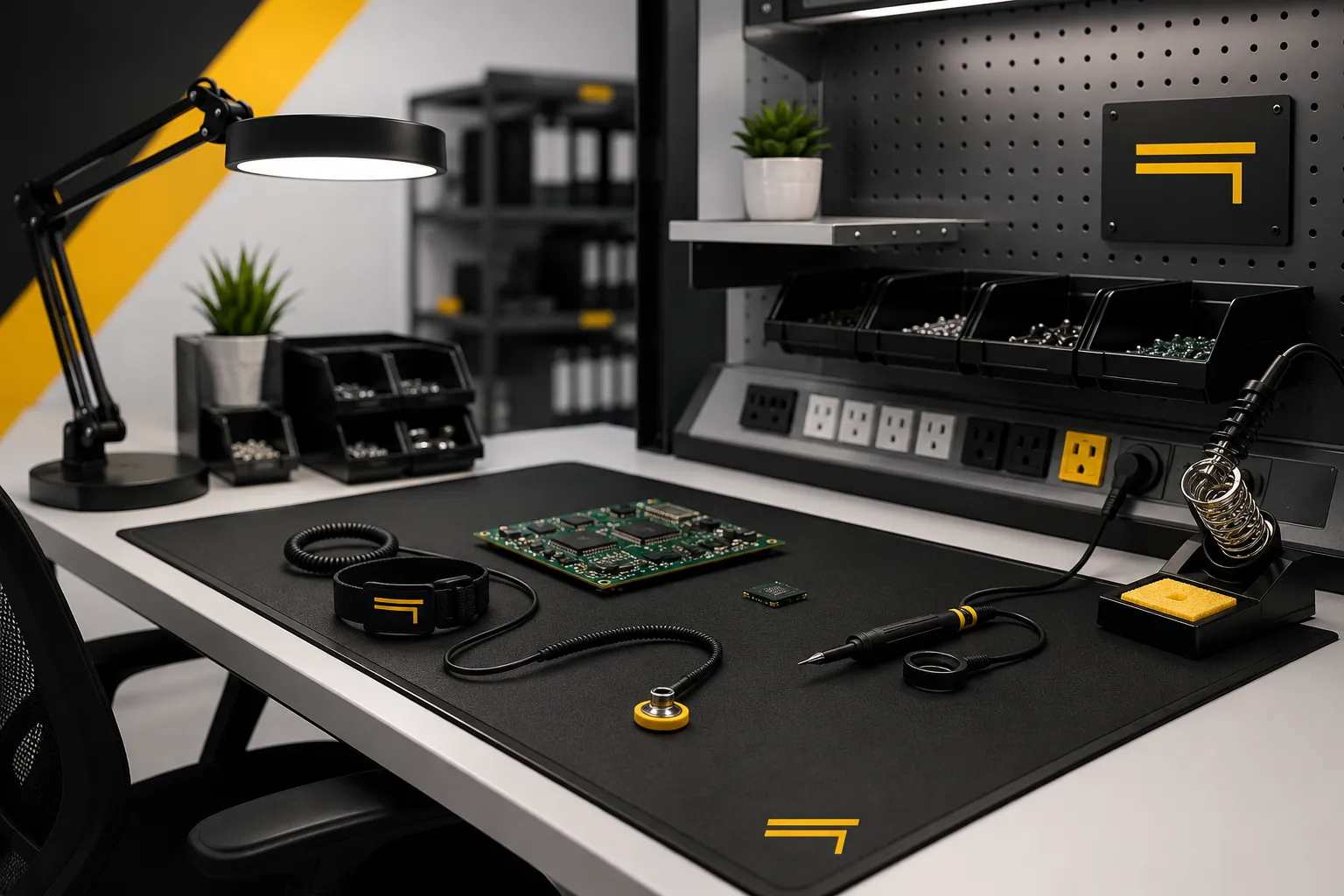
Choosing an ESD workstation is about more than finding a bench with an ESD-safe surface. The workstation needs to support your ESD control program while fitting the people, equipment, workflow, and space within your facility.
That can look different from one operation to another. An electronics assembly area may need organized component storage and integrated power, while a testing environment may prioritize equipment placement and cable management. A facility with changing production requirements may need a workstation that can be reconfigured as processes evolve.
By evaluating the complete application before choosing a workstation, you can create a workspace that supports ESD control without sacrificing efficiency or flexibility.
Start With Your ESD Control Requirements
Before considering workstation dimensions, storage, or accessories, begin with the ESD requirements of your application.
Consider the sensitivity of the components being handled and how the workstation fits into your facility’s overall ESD control program. This can influence decisions about work surfaces, grounding, storage, seating, and other workstation components.
The goal is to select an ESD workstation that works as part of your established ESD-protected area, rather than treating the bench as a standalone solution.
If your organization follows specific ESD standards or internal procedures, those requirements should also be considered during workstation planning.
Consider the Work Being Performed
The workstation should be designed around the task.
Start by looking at what employees actually do at the station. Are they assembling products, inspecting components, performing repairs, conducting tests, or completing several different tasks?
Then consider what needs to be within reach.
Tools, monitors, test equipment, parts bins, documentation, lighting, and other frequently used items all influence how the workstation should be configured.
A workstation designed around the workflow can help employees spend less time reaching for tools, moving equipment, or searching for components.
Choose the Right ESD Work Surface
The work surface is a key part of an ESD workstation.
Depending on the application, facilities may use static-dissipative surfaces or other ESD-compatible materials designed to help manage electrostatic charge when properly incorporated into the facility’s grounding system.
The right surface should also match the physical demands of the work. Consider factors such as equipment weight, cleaning requirements, chemical exposure, and everyday wear.
Selecting the work surface based on both ESD requirements and actual use can help create a workstation that performs reliably over time.
Plan for Proper Grounding
An ESD workstation needs to integrate with the grounding approach used within the facility’s ESD control program.
Depending on the application, the configuration may include grounding points for the work surface, wrist straps, and other ESD control components.
Grounding connections should also be positioned with everyday use in mind. Operators should be able to connect necessary equipment without cords interfering with their work.
Because ESD requirements can vary, grounding should be planned according to your organization’s ESD control procedures and applicable standards.
Think About Ergonomics
ESD protection is essential, but employees also need a workstation that supports comfortable and efficient work.
Consider the height of the work surface, reach distances, monitor placement, lighting, seating, and the location of frequently used tools and materials.
For shared workstations or facilities with varied tasks, adjustable components can provide additional flexibility. Depending on the application, this might include adjustable work surfaces, shelves, monitor arms, footrests, or lighting.
The objective is to create a workstation that fits the operator and the process instead of requiring the operator to adapt to a fixed setup.
Evaluate Storage and Organization
Storage can have a significant impact on workstation efficiency.
Parts, tools, and supplies should be organized so employees can access what they need without overcrowding the work surface. Depending on the process, an ESD workstation might incorporate:
- ESD-compatible bins and component storage
- Adjustable shelving
- Drawers
- Tool storage
- Overhead structures
- Equipment holders
Storage should reflect how frequently items are used. Keeping commonly used components within easy reach can help create a more organized and efficient workflow.
Account for Power, Data, and Equipment
Modern ESD workstations often support much more than hand tools.
Computers, monitors, test equipment, lighting, charging equipment, and other devices can create significant power and cable-management requirements.
Planning for these needs before the workstation is installed can help reduce clutter and avoid improvised solutions later.
Consider how much equipment will be used, where it needs to sit, how operators will access it, and how power and data cables will be routed.
Consider Your Available Space
A workstation needs to fit both the process and the facility.
Measure the available area and consider more than the workstation footprint. Employees need sufficient room to work, move, access storage, and interact safely with nearby equipment.
The layout should also account for surrounding workstations and the flow of materials through the area.
For facilities trying to maximize existing floor space, vertical storage and overhead accessories can provide additional functionality without significantly increasing the workstation footprint.
Plan for Future Changes
Today’s workstation requirements may not be the same a few years, or even a few months, from now.
Production volumes change. New products are introduced. Equipment is replaced. Teams grow. Processes move.
A modular ESD workstation can make it easier to respond to these changes. Shelving, storage, accessories, and equipment placement can be adjusted or expanded as requirements evolve.
This flexibility can be especially valuable in electronics, semiconductor, aerospace, medical device, and other manufacturing environments where processes and product requirements frequently change.
Look Beyond a Standard Workstation Configuration
Standard workstation configurations can work well when requirements are straightforward. However, specialized processes often call for a more tailored approach. When standard solutions are not enough, a custom ESD workstation can be configured around your equipment, workflow, space, and ESD requirements.
You may need a particular work surface size, unusual equipment placement, additional storage, specific accessory locations, or a configuration designed around an existing production layout.
In these situations, customization can help you address the actual requirements of the workspace without forcing your process into a predetermined workstation design.
Questions to Ask Before Choosing an ESD Workstation
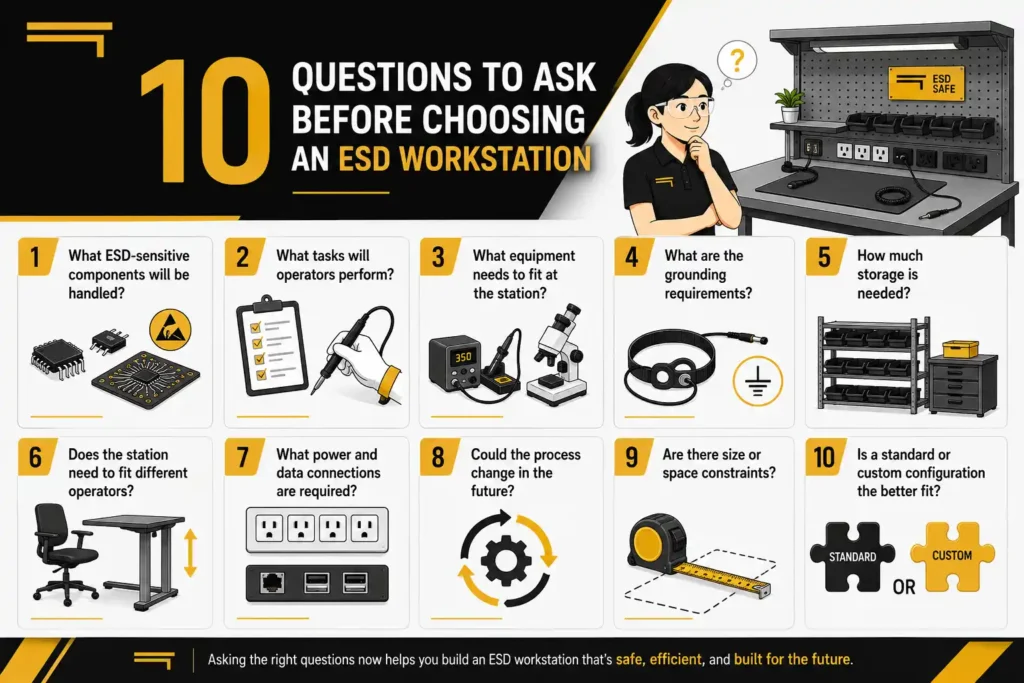
Before making a final decision, ask:
- What ESD-sensitive components will be handled?
- What tasks will operators perform?
- What equipment needs to fit on or around the workstation?
- What are our grounding requirements?
- How much storage is needed?
- Does the workstation need to accommodate different operators?
- What power and data connections are required?
- Could the process or layout change in the future?
- Are there facility-specific size or space constraints?
- Would a standard configuration work, or is customization needed?
Answering these questions gives your workstation supplier a much clearer picture of what you need.
Finding the Right ESD Workstation for Your Facility
There is no single ESD workstation configuration that is right for every facility. The best solution is one that brings ESD control, workflow, equipment, ergonomics, and available space together.
Bench-Tek works collaboratively with customers to understand these requirements and translate them into practical workstation configurations. Whether you need a straightforward ESD bench or a customized setup built around specific equipment and processes, the goal is to make the customization process simple and precise.
Key Takeaways
- The right ESD workstation should support your facility’s ESD control requirements while fitting the specific work being performed.
- Work surfaces, grounding, storage, ergonomics, power, and equipment placement should be considered as part of the complete workstation design.
- Designing around the operator and workflow can help create a more organized and efficient workspace.
- Modular ESD workstations provide flexibility when equipment, processes, or production requirements change.
- Standard configurations may work for straightforward applications, while custom ESD workstations can address specialized equipment, space, workflow, and operational requirements.
- Evaluating current and future needs before selecting a workstation can help avoid limitations as your facility evolves.