
Choosing the right laboratory workbench for a cleanroom environment requires more than finding a bench that fits the available space. The workbench needs to support cleanliness requirements, daily workflows, equipment, ergonomics, and future changes without creating unnecessary complications.
For facilities in industries such as medical device manufacturing, biotech, semiconductor production, aerospace, and electronics, the right cleanroom workbench can help improve organization, reduce contamination risks, and create a more efficient working environment.
Here are the key factors to consider when selecting a laboratory workbench for a cleanroom.
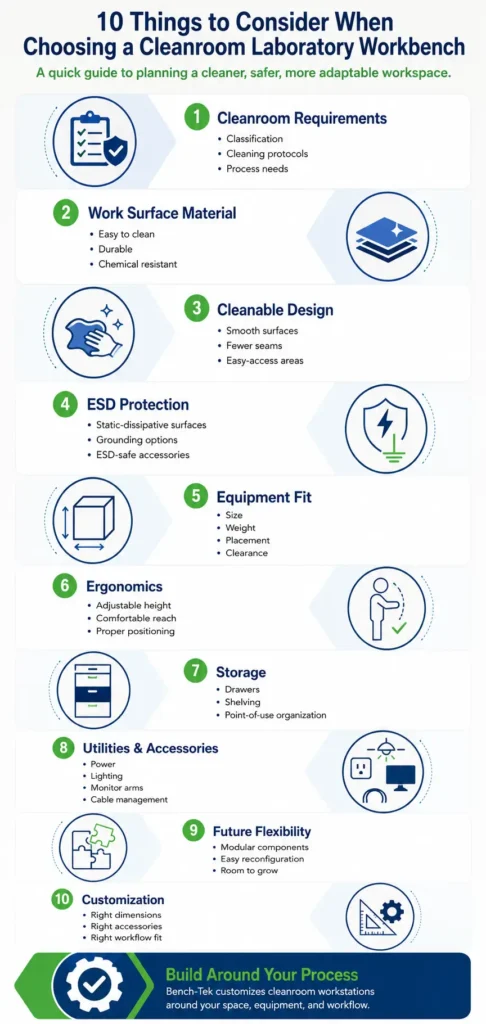
1. Start With Your Cleanroom Requirements
Every cleanroom has different operating requirements, so the first step is understanding the environment where the workbench will be used.
Consider factors such as:
- Cleanroom classification
- Cleaning and sanitation procedures
- Type of work being performed
- Materials and chemicals used
- Equipment placed on the bench
- Static-control requirements
- Storage needs
- Available floor space
A workbench that performs well in one cleanroom may not be appropriate for another. Defining these requirements early makes it easier to select materials, surfaces, accessories, and configurations that support the application.
2. Choose Materials That Are Easy to Clean
Cleanroom furniture should be designed with surfaces that are easy to wipe down and maintain.
Materials should generally be smooth, durable, and resistant to the cleaning agents used in the facility. Stainless steel is commonly used in cleanroom environments because it is durable, easy to clean, and resistant to corrosion.
Depending on the application, other surface materials may also be appropriate.
The most important consideration is matching the work surface to the facility’s cleaning protocols and the type of work being performed.
3. Minimize Areas Where Contaminants Can Collect
Workbench design can affect how easily a cleanroom can be maintained.
Complex shapes, unnecessary seams, difficult-to-reach corners, and excessive hardware can create areas where dust or contaminants accumulate.
When selecting a cleanroom laboratory workbench, look for a design that supports straightforward cleaning and minimizes hard-to-access areas.
Open-frame configurations can also make it easier to clean beneath and around the workstation.
4. Consider ESD Protection When Necessary
Some cleanroom applications involve sensitive electronic components or equipment that can be damaged by electrostatic discharge.
In these environments, an ESD-safe laboratory workbench may be required.
An ESD workstation can include features such as:
- Static-dissipative work surfaces
- Grounding points
- ESD-safe accessories
- Grounding systems for equipment and operators
It is important to evaluate ESD requirements during the planning process rather than adding them after the workstation has been installed.
5. Plan Around the Equipment
A cleanroom workbench should support the equipment operators use every day.
Before selecting a bench, document the size, weight, placement, and utility requirements of equipment such as microscopes, test instruments, monitors, tools, and processing equipment.
This information helps determine:
- Workbench dimensions
- Weight capacity
- Shelf placement
- Accessory locations
- Electrical requirements
- Storage configuration
Designing the workbench around the actual equipment can create a more organized workspace and reduce unnecessary movement.
6. Think About Ergonomics
Cleanroom operators may spend long periods working at the same station. Ergonomics should therefore be part of the workbench selection process.
Height-adjustable laboratory workbenches can allow different operators to position the work surface at a comfortable working height.
Other ergonomic considerations may include:
- Monitor positioning
- Tool placement
- Shelf height
- Legroom
- Reach distances
- Seating requirements
A well-planned workstation can help operators work more comfortably while keeping frequently used tools and equipment within easy reach.
7. Include the Right Storage Without Overcrowding the Workstation
Storage can improve organization, but it should be planned carefully in a cleanroom.
Drawers, shelves, and other storage components should support the workflow without making the workstation difficult to clean or limiting access.
Consider what employees actually need at the point of use. Frequently used tools and materials should be easy to access, while unnecessary items can be stored elsewhere.
Modular storage options can make it easier to adjust the workstation as processes change.
8. Plan for Utilities and Accessories
Laboratory workbenches often need to support electrical equipment, lighting, monitors, instruments, or other accessories.
Planning these requirements in advance can help create a cleaner and more functional workspace.
Depending on the application, a workstation may include:
- Electrical outlets
- Overhead lighting
- Monitor arms
- Shelving
- Tool rails
- Equipment supports
- Cable-management features
Integrating these features into the original design can help prevent clutter and reduce the need for temporary solutions later.
9. Consider Future Changes
Cleanroom processes rarely remain exactly the same.
New equipment may be introduced, production volumes may increase, or workflows may change. A workstation that can be reconfigured may provide more value over time than one designed around a single fixed process.
Modular laboratory workbenches can allow shelves, storage, accessories, and other components to be repositioned as requirements evolve.
This flexibility can help facilities adapt without replacing the entire workstation.
10. Work With a Manufacturer That Can Customize the Solution
Cleanroom workstations often need to meet a combination of space, equipment, workflow, material, and operational requirements.
A configurable or custom laboratory workbench allows the workstation to be designed around those requirements instead of forcing the facility to adapt to a standard product.
Bench-Tek works with customers to translate their requirements into practical workstation configurations. Dimensions, work surfaces, storage, shelving, accessories, and other features can be adjusted to support the specific application.
The goal is to create a workstation that fits the cleanroom, supports the operator, and works with the process from day one.
Choosing the Right Cleanroom Laboratory Workbench
The best laboratory workbench for a cleanroom environment is one that supports cleanliness, workflow, ergonomics, equipment, and future flexibility.
By considering materials, cleanability, ESD requirements, storage, utilities, and customization early in the planning process, facilities can create workstations that are easier to maintain and better suited to the work being performed.
For cleanrooms with unique equipment, dimensions, or workflow requirements, Bench-Tek can help develop a custom workstation that brings those needs together in one practical, well-planned solution.
Key Takeaways
- Choose a laboratory workbench based on the cleanroom’s classification, workflow, equipment, and cleaning requirements.
- Select materials and work surfaces that are durable, easy to clean, and appropriate for the chemicals and processes used in the space.
- Consider ESD protection when working with sensitive electronic components or equipment.
- Plan storage, shelving, utilities, and accessories around the operator’s actual workflow.
- Height-adjustable and ergonomic features can help improve comfort and usability during long work periods.
- Modular workbenches can make it easier to adapt the workspace as equipment, processes, or production needs change.
- Bench-Tek can customize cleanroom workstations to match specific dimensions, equipment, storage, and workflow requirements.