
Getting a quote for a custom workstation does not require a complete design or detailed specification sheet. A manufacturer can start with basic information about your application, space, equipment, and requirements, then help define the remaining details.
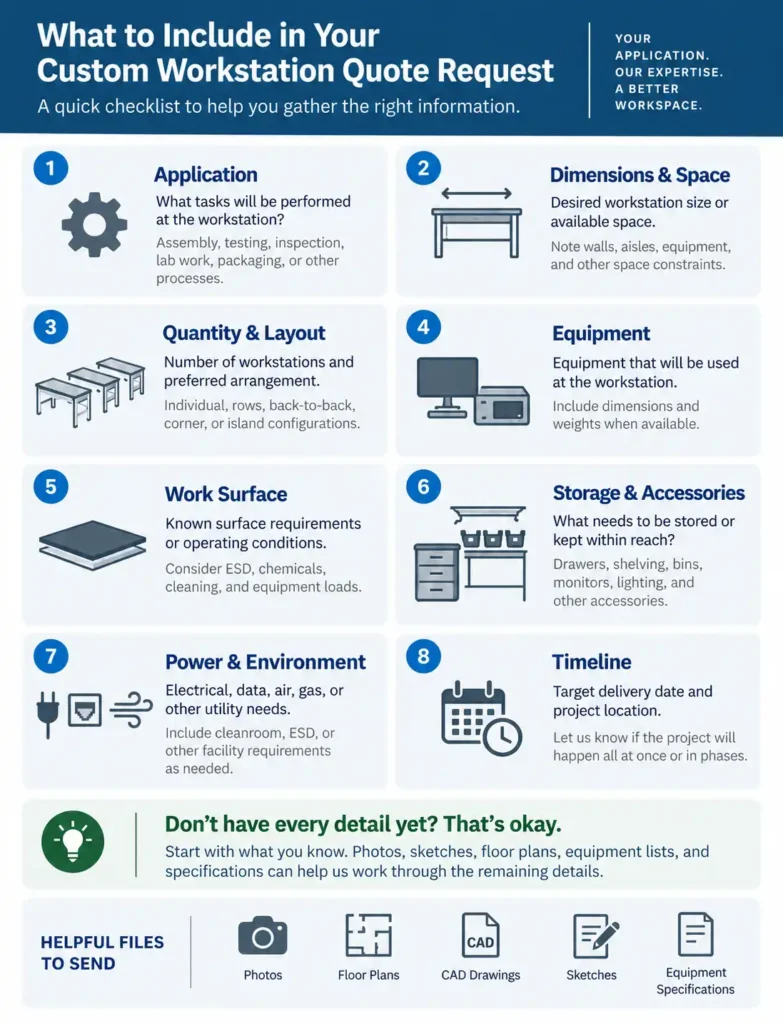
Providing the right information upfront makes the quoting process more efficient and helps ensure the proposed workstation fits your space, workflow, and application. Here is what to include when requesting a custom workstation quote.
How Will the Workstation Be Used?
Start by describing what will happen at the workstation. Explain whether it will be used for assembly, testing, inspection, packaging, laboratory work, or another process. It also helps to identify who will use it, whether they will sit or stand, and what tools or equipment they need to access.
The application gives the manufacturer context for the rest of the workstation design. For example, an electronics assembly station may require ESD protection and organized component storage, while a laboratory workstation may have different requirements for work surfaces, equipment, and utilities.
What Size Workstation Do You Need?
Provide the desired width, depth, and height if those dimensions are already known. If they are not, share the dimensions of the available space so the manufacturer can help determine an appropriate workstation size.
Include any space constraints that could affect the design or placement, such as walls, columns, doors, aisles, nearby equipment, or required clearances. For larger projects, a floor plan can be especially useful.
How Many Workstations Do You Need?
Include the number of workstations you expect to purchase and how they will be arranged. This could include individual stations, rows, back-to-back configurations, islands, corner configurations, or a combination of layouts.
If the final quantity is not known yet, provide an estimate. You should also mention if the project will be completed in phases, such as starting with a pilot area and adding more workstations later.
What Type of Work Surface Does the Application Require?
If you already know the work surface material you need, include it in your request. If not, describe the conditions the surface needs to handle.
Important considerations include chemical exposure, ESD requirements, cleaning procedures, equipment loads, and the general type of work being performed. With this information, the manufacturer can help identify a surface that fits the application.
What Equipment Will the Workstation Support?
Provide a list of the equipment that will sit on, above, or below the workstation. Include dimensions and weights when available, particularly for large or heavy equipment.
It is also helpful to explain where equipment needs to be positioned. For example, some equipment may need to remain directly in front of the operator, while other items can be placed on shelves or underneath the work surface. Equipment specifications can help the manufacturer plan the workstation around these requirements.
What Storage and Accessories Do You Need?
Identify what operators need to store and access during their work. This may include tools, components, documents, computers, test equipment, or personal items.
From there, the workstation can be configured with appropriate storage and accessories, such as drawers, cabinets, shelving, bin rails, monitor arms, keyboard trays, task lighting, CPU holders, and footrests. If you are unsure which accessories you need, describing what needs to be stored or accessed is a good starting point.
What Power, Data, or Utilities Are Required?
List the connections and utilities needed at the workstation. Depending on the application, this may include electrical outlets, data connections, compressed air, gases, or other utilities.
Also consider where these connections need to be located in relation to the operator and equipment. Addressing these requirements during the design process can create a cleaner setup and reduce the need for additions after installation.
Are There Ergonomic Requirements?
Explain whether operators will work seated, standing, or alternate between the two. If several people will share the workstation, mention that as well.
These details can help determine whether adjustable-height features or other ergonomic options should be considered. Monitor placement, shelving, storage, and frequently used tools can also be positioned based on how operators work at the station.
Are There Facility or Environmental Requirements?
Tell the manufacturer about any requirements specific to the environment where the workstation will be used. These could include cleanroom compatibility, ESD control, chemical resistance, cleaning procedures, or other requirements associated with laboratory and controlled manufacturing environments.
If your organization follows specific facility standards or specifications, include those documents with the quote request when possible. This gives the manufacturer clear requirements to work from.
What Is the Project Timeline?
Provide your target delivery or installation date along with the project location. This helps the manufacturer understand the overall schedule and determine how the workstation project fits within it.
For larger projects, explain whether all workstations are needed at once or whether the project will be completed in phases. Sharing this information early can help with planning for both the initial order and future expansion.
What If You Don’t Have All the Details Yet?
You do not need every workstation specification finalized before requesting a quote. Start with the information you already know, such as the application, available space, equipment, quantity, and important facility requirements.
A workstation manufacturer can help work through details such as dimensions, materials, storage, accessories, and equipment placement. The goal is to turn your operational requirements into a practical workstation configuration, rather than requiring you to design the workstation yourself.
What Should You Send With Your Quote Request?
Supporting materials can make it easier to understand your requirements. Useful information includes floor plans, CAD drawings, sketches, photos of the existing workspace, equipment lists, equipment specification sheets, and facility requirements.
Photos of your current setup can be particularly helpful when replacing or improving existing workstations. Point out issues such as limited storage, crowded work surfaces, poor equipment placement, or other workflow problems you want the new workstation to address.
Requesting a Custom Workstation Quote
A useful quote request should give the manufacturer a clear understanding of what the workstation needs to support. Start with the application, dimensions or available space, quantity, equipment, work surface requirements, storage, utilities, environmental requirements, and timeline.
If some details are still undecided, that should not prevent you from starting the process. At Bench-Tek, we work with customers to understand their requirements and help turn them into a workstation configuration that fits the application.
If you are planning a custom workstation project, send us the information you already have, along with any drawings, photos, or equipment specifications. We can help you work through the remaining details and prepare a quote based on your requirements.
Key Takeaways
- You do not need a complete workstation design before requesting a custom quote.
- Provide details about the application, available space, quantity, equipment, work surface, storage, utilities, and facility requirements.
- Photos, floor plans, sketches, and equipment specifications can help clarify project requirements.
- Sharing your timeline and project location helps the manufacturer plan around delivery and project needs.
- A workstation manufacturer can help refine specifications and develop a configuration based on your application.